November 2026 Militaria and Political Auction · Lot 1237
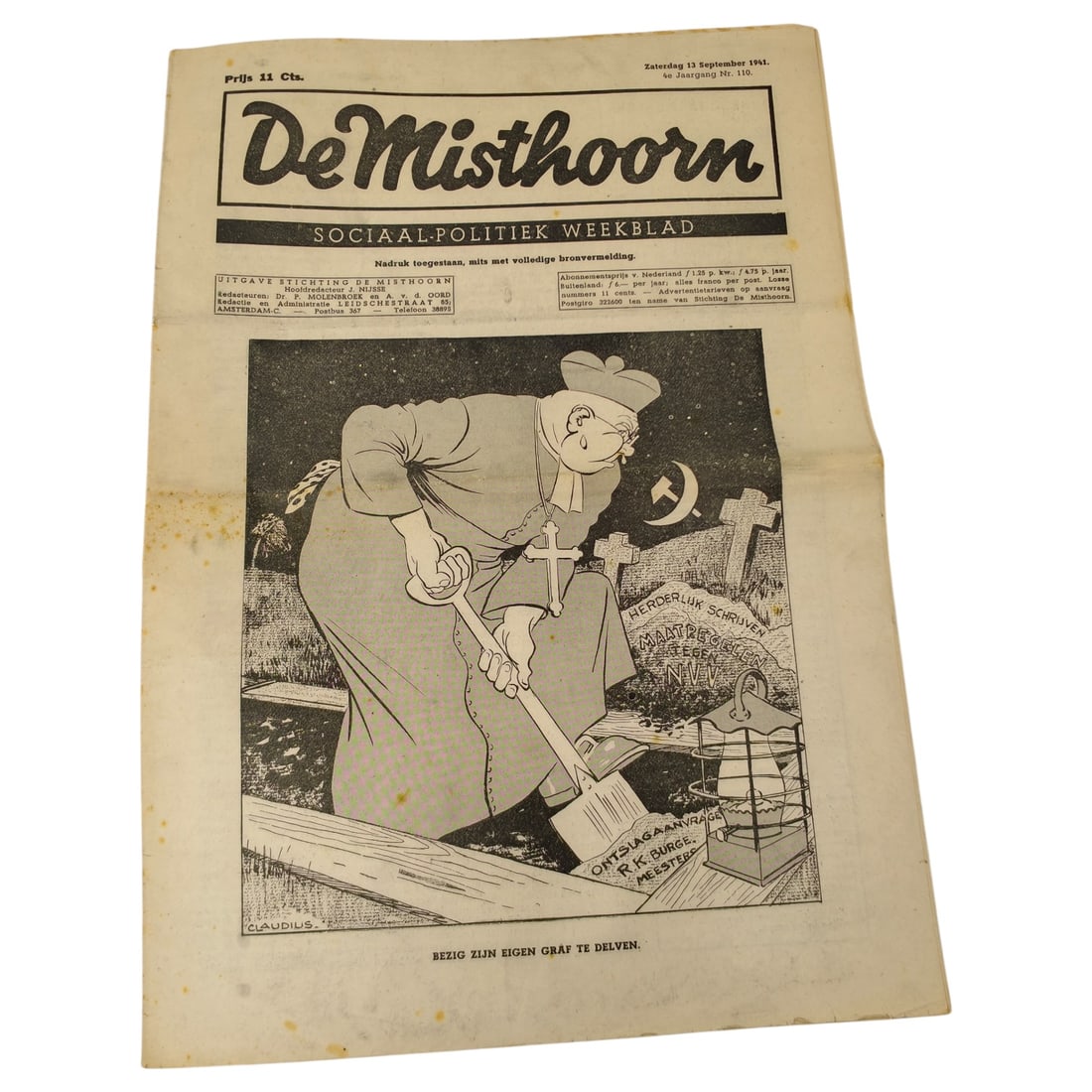
Dutch WWII Newspaper "De Misthoorn" - Sociaal-Politiek Weekblad, 13 September 1941
A wartime Dutch weekly newspaper, "De Misthoorn, " 4th Jaargang, Nr. 110, dated Saturday 13 September 1941, published by Stichting De Misthoorn in Amsterdam. The front page carries a political cartoon signed "Claudius" depicting a clergyman digging his own grave in a churchyard, with a hammer-and-sickle symbol, gravestones, and text referencing a "Herderlijk Schrijven" (pastoral letter) directed against the NSB, captioned "Bezig zijn eigen graf te delven."
De Misthoorn was a Dutch National Socialist-aligned weekly circulated during the German occupation of the Netherlands, using satirical cartoons and commentary to attack political and religious opposition to the occupation regime, making surviving issues a primary-source record of collaborationist press activity in the occupied Netherlands.
This issue dates from the German occupation of the Netherlands (19401945), when the Dutch press was subject to censorship and propaganda directives from the occupying authorities and their Dutch National Socialist (NSB) allies. The cartoon attacking a bishops' pastoral letter reflects the ongoing conflict between the occupation regime and the Dutch Catholic and Protestant churches, which in 1941 publicly opposed NSB membership and collaboration, prompting sharp reprisals in the collaborationist press. Such publications served as vehicles for anti-clerical and anti-resistance propaganda, and surviving copies are studied today as primary sources for understanding wartime media control and collaboration in the occupied Netherlands.
De Misthoorn was a Dutch National Socialist-aligned satirical weekly published in Amsterdam during the German occupation, used to attack political and religious opposition to the NSB and the occupation regime through cartoons and polemical commentary. This 1941 issue's front-page cartoon responds to a pastoral letter issued by Dutch bishops condemning NSB membership, part of the broader confrontation between the Dutch churches and the collaborationist movement that intensified through 1941. Such pastoral letters prompted excommunication-style warnings to Catholics who joined the NSB, and the collaborationist press regularly retaliated with anti-clerical propaganda of this kind. Surviving issues serve as primary evidence of wartime press collaboration and the ideological battle between the churches and Dutch National Socialism under German occupation.
Catalogued for November 2026 Militaria and Political Auction. This lot is not for sale on this site. Ask us about similar pieces