November 2026 Militaria and Political Auction · Lot 1198
German 1923 Bavarian Wehrkreiskommando VII Document Signed by Ernst Rohm
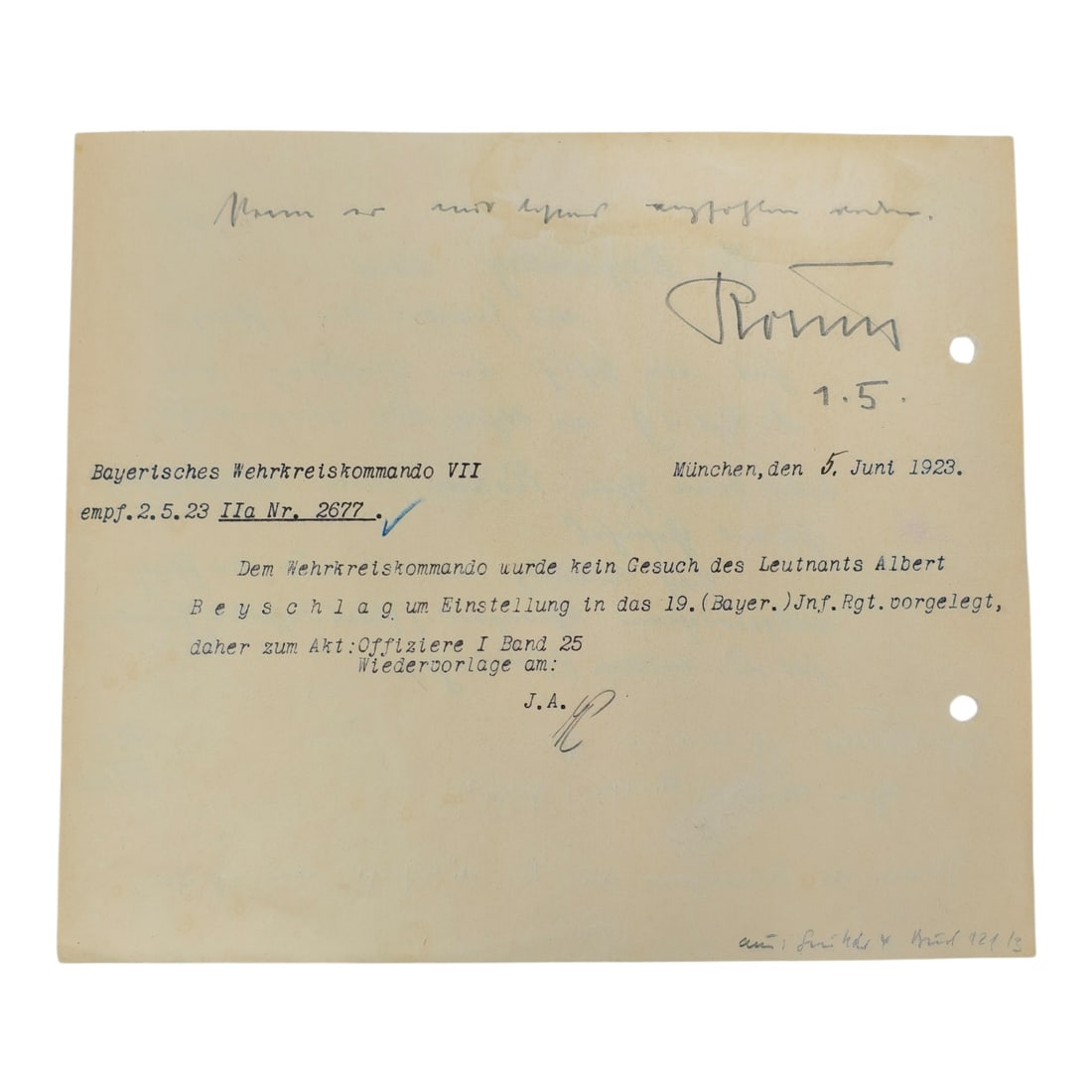
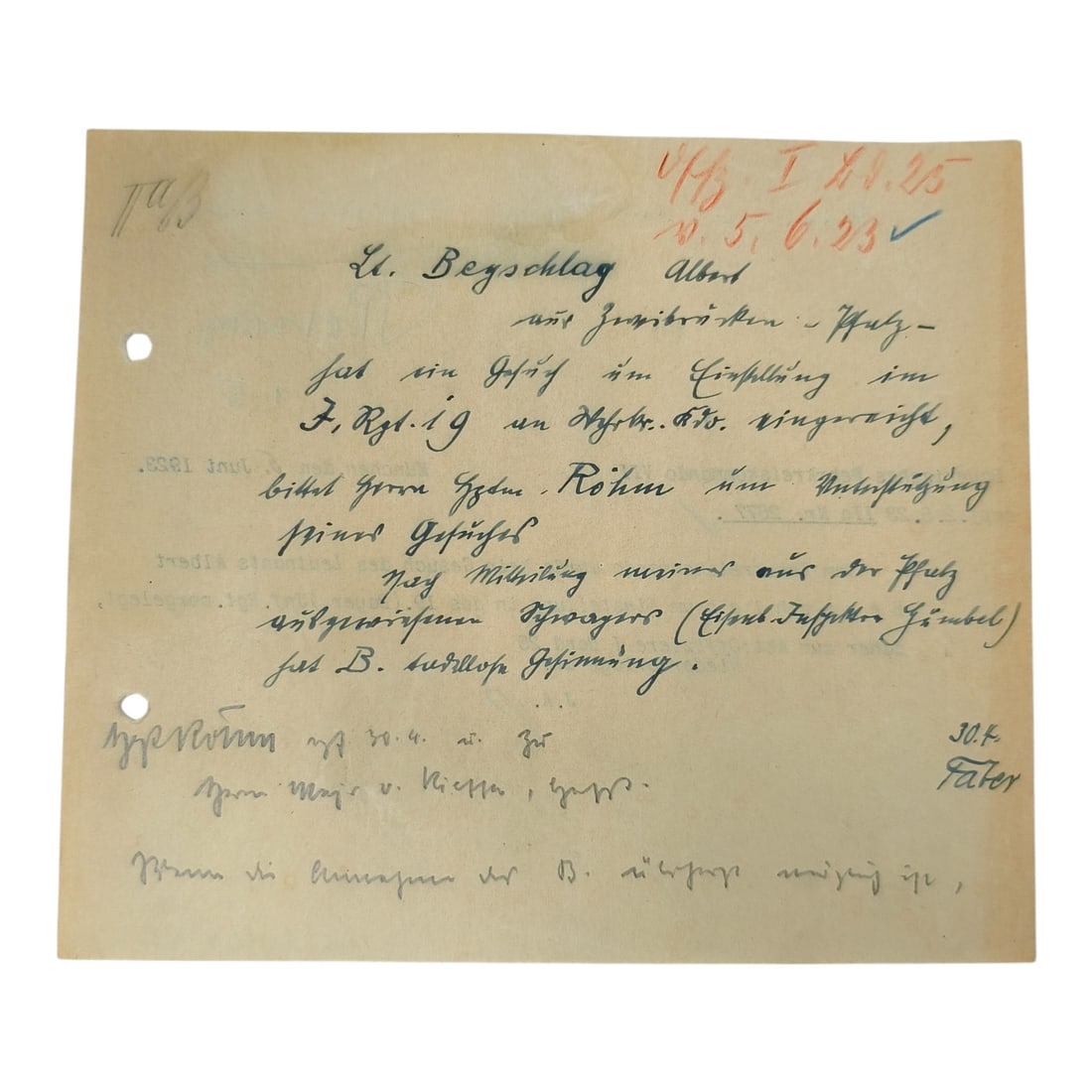
German 1923 Bavarian Wehrkreiskommando VII Document Signed "Roehm", concerning Leutnant Albert Beyschlag's petition for reinstatement into the 19th Bavarian Infantry Regiment. The typed first page carries office stamps and file references (IIa Nr. 2677, Akt: Offiziere I Band 25) along with the ink signature "Roehm" at the top. The accompanying handwritten sheet elaborates on Beyschlag's prior service in the Pfalz region, out of Zweibruecken, and records his direct appeal to "Herrn Oberst Roehm" for assistance in the matter, closing with a second signature reading "Faber."
Ernst Roehm served in the early 1920s within Bavarian military and paramilitary circles, holding administrative roles connected to the Reichswehr's district commands before his later prominence as head of the Sturmabteilung (SA). Correspondence of this kind, generated through the Wehrkreiskommando VII in Munich, documents the routine bureaucratic processing of officer personnel matters in the Bavarian military district during the Weimar period, with Roehm's signature placing him directly within that administrative chain in 1923.
Wehrkreiskommando VII, headquartered in Munich, administered Reichswehr affairs across Bavaria during the Weimar Republic, handling matters such as officer postings, discharges, and reinstatements amid the drastic force reductions imposed by the Treaty of Versailles. Ernst Roehm, a decorated First World War officer, worked within Bavarian military circles in the early 1920s while simultaneously cultivating the paramilitary networks that fed into the fledgling SA, of which he became the founding organiser and later supreme leader. Petitions like Leutnant Beyschlag's, seeking restoration to his old regiment, reflect the precarious position of many junior officers whose careers were disrupted by the postwar army's contraction to 100,000 men.
Ernst Roehm, a decorated First World War officer, worked within Bavarian military administration in the early 1920s while simultaneously helping organise the paramilitary networks that fed into the fledgling Sturmabteilung, of which he became founding organiser and later supreme leader until his death in the 1934 purge. Wehrkreiskommando VII, headquartered in Munich, administered Reichswehr affairs across Bavaria during the Weimar Republic, processing officer postings, discharges, and reinstatements amid the drastic reductions imposed on the army by the Treaty of Versailles. Petitions such as Leutnant Beyschlag's, seeking restoration to his former regiment, illustrate the precarious position of junior officers whose careers were disrupted when the postwar army was cut to 100,000 men, and this document places Roehm directly within that routine administrative chain shortly before his rise to wider political prominence.
Catalogued for November 2026 Militaria and Political Auction. This lot is not for sale on this site. Ask us about similar pieces