November 2026 Militaria and Political Auction · Lot 1139
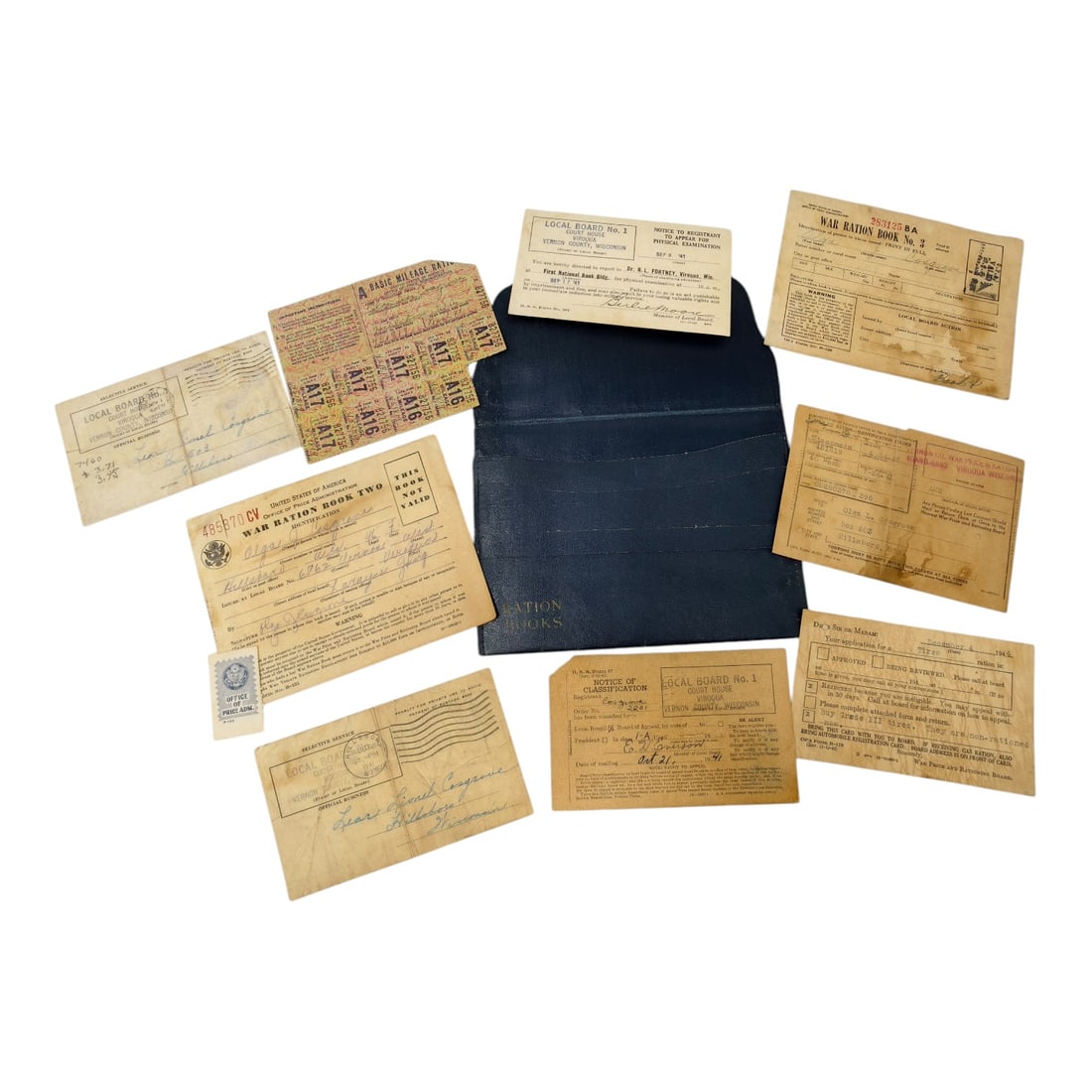
US WWII Home Front Ration Book and Selective Service Document Set
- Price realized
- $20
- hammer, buyer's premium excluded · November 2026 Militaria and Political Auction
A set of American WWII-era paper items belonging to a Wisconsin registrant, including War Ration Book No. 2, War Ration Book No. 3, a Basic Mileage Ration booklet with printed gasoline coupons, and a black ration book storage envelope. The set also includes Selective Service paperwork issued by Local Board No. 1 and No. 3 of Eau Claire and Chippewa Counties, Wisconsin, such as a Notice to Registrant to Appear for Physical Examination, a Notice of Classification, and related mailing envelopes.
These materials document the coordinated civilian rationing and draft registration systems administered on the home front during World War II, when local draft boards and ration boards issued paperwork to individual citizens for both military service tracking and the regulation of scarce commodities such as gasoline and food.
During World War II, the U.S. Office of Price Administration issued war ration books to civilians to control the distribution of scarce goods such as sugar, coffee, meat, and gasoline, with coupons required alongside cash for authorized purchases. Concurrently, the Selective Service System operated through thousands of local draft boards, such as those in Eau Claire and Chippewa Counties, Wisconsin, which classified registrants, summoned them for physical examinations, and administered conscription on a community level. Together these documents reflect the day-to-day bureaucratic experience of an individual American civilian navigating both the rationing economy and the draft process during the war.
These documents illustrate the dual civilian obligations imposed on Americans during World War II: participation in the rationing economy administered by the Office of Price Administration and registration under the Selective Service System. Ration books and mileage coupons governed household access to controlled commodities like sugar, meat, and gasoline, reflecting wartime shortages and the government's efforts to allocate resources toward the war effort. Meanwhile, local draft boards such as those in Eau Claire and Chippewa Counties, Wisconsin, processed individual registrants through classification and physical examination, forming the community-level machinery of national conscription. Together, they represent the routine paperwork through which one Wisconsin resident experienced the home front war years.
Sold in November 2026 Militaria and Political Auction. This lot is not available to buy. Ask us about similar pieces